



What types of forklifts are there? An overview of the most important forklift types.
Forklifts are among the most important industrial trucks in warehouses, production facilities, logistics centers, ports, and construction sites. They transport pallets, store goods, move heavy machinery, and handle containers. However, not every type of forklift is suitable for every task.
A counterbalance forklift, for example, is particularly versatile but requires a relatively large amount of maneuvering space. A reach truck, on the other hand, is designed for narrow warehouse aisles and high lifting heights. Heavy-duty forklifts are used for particularly heavy loads, while reach stackers are primarily used for container handling.
Pallet trucks are also considered industrial trucks. Low-lift pallet trucks transport pallets over short or medium distances, while high-lift pallet trucks can also lift loads and store them in racks.
In this guide, we introduce the most important types of forklifts and explain how they work, where they are used, and what advantages they offer.
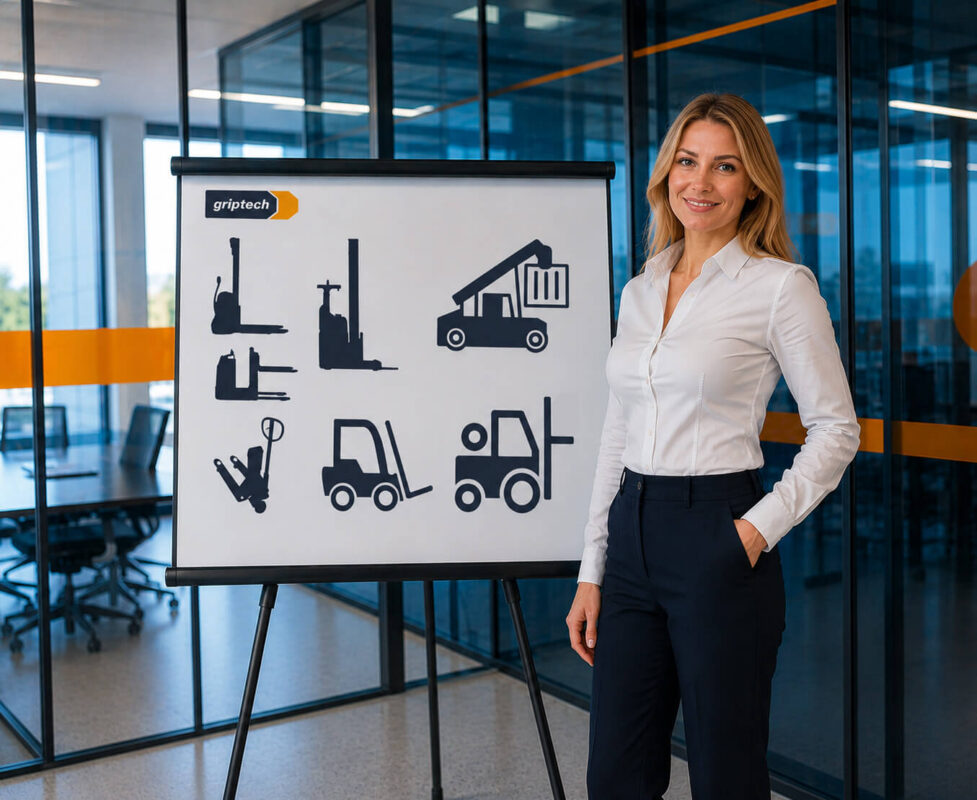
Overview of forklift types
| Forklift type | Typical Einsatzgebiet | Special Features |
|---|---|---|
| counterbalanced truck | Warehouse, production and outdoor area | Versatile standard forklift |
| Reach truck | High-bay warehouses and narrow storage aisles | Compact design and large lifting height |
| Heavy-duty forklifts | Ports, steel industry and mechanical engineering | Very high load capacity |
| Reach stacker | Container terminals and freight yards | Container handling with telescopic boom |
| Sideloader | Wood, steel and building materials industry | Transport of long loads |
| Four-way forklift | Storage of long goods | Travel in multiple directions |
| narrow aisle forklift | High-bay warehouse with narrow aisles | Particularly small space requirement |
| Telehandler | Construction sites and agriculture | Long range and off-road capability |
| Niederhubwagen | Internal pallet transport | Ground-level transport |
| stacker truck | Storage and short transport routes | Lifting and storing pallets |
| Scissor lift truck | Production and order picking | Ergonomic working height |
| hand pallet truck | Short transport routes | Simple, flexible and cost-effective |
Counterbalance forklift – the classic front forklift
Counterbalance forklifts, also known as front-loading forklifts or front-loading forklifts, are among the best-known and most frequently used types of forklifts. The forks and the lifting mechanism are located at the front of the vehicle. A counterweight at the rear ensures that the forklift remains stable despite the load it is carrying.
The driver typically sits facing forward, giving them a good view of the route and the load being transported. Counterbalance forklifts can pick up, transport, stack, and store pallets in racks.
Depending on the work environment, different drive types are available. Electric forklifts operate quietly and with zero local emissions, making them particularly suitable for warehouses, production areas, and other indoor spaces. Diesel and LPG forklifts are frequently used outdoors or for demanding continuous operations.
Typical applications of counterbalance forklifts
Counterbalance forklifts are used in the following areas, among others:
- Warehouses and logistics centers
- Production plants
- Shipping and receiving areas
- Wholesale and building materials trade
- Loading and unloading of trucks
- External warehouses and depots
Their greatest strength is their versatility. A counterbalance forklift can be equipped with different forks and Attachments equipped and thus adapted to different loads.
Compared to specialized warehouse equipment, a front-loading forklift requires more maneuvering space. For particularly narrow warehouse aisles, reach trucks or narrow-aisle forklifts are therefore often better suited.
Attachments and accessories for counterbalance forklifts
The range of applications for a counterbalance forklift can be significantly expanded by using suitable attachments. KOOI®Reachforks This allows, for example, the telescopic extension of the fork tines. This makes it possible to bridge gaps between pallets, store them double-deep, or load and unload trucks from one side.
Fork positioners They hydraulically adjust the distance between the fork tines to accommodate different load widths. Multi pallet handler It is possible to pick up several pallets at the same time. Clamps, Roll clamps and Spinning Playground Equipment enable the handling of special goods and containers.
Non-personal or anonymized information remains protected by tax secrecy. Disclosure to third parties is only allowed if no identification is possible and both states confirm that no harm to tax administration will occur. Camera systems and Weighing systems They can be used directly on the forklift. They assist the driver with load picking and make it possible to check or weigh goods during the transport process.
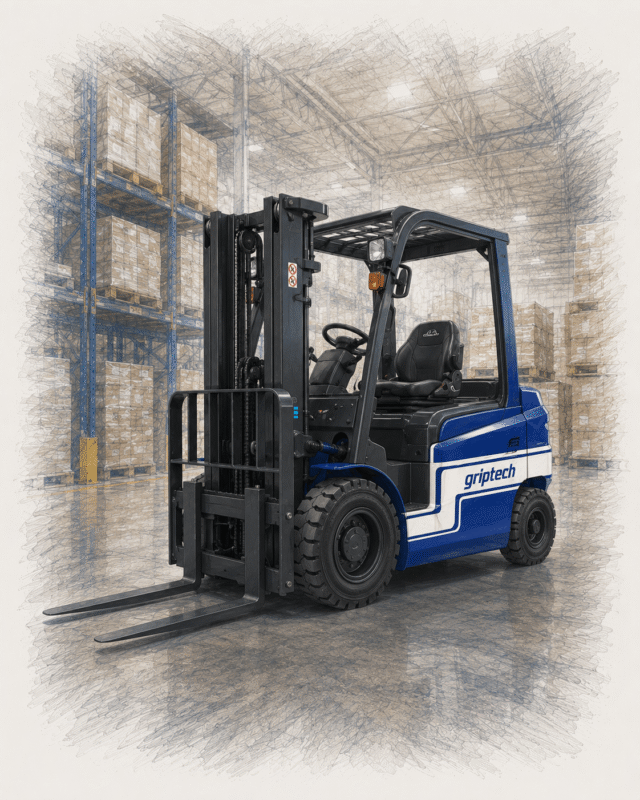
Reach trucks for high-bay warehouses and narrow aisles
Reach trucks are specifically designed for use in warehouses and high-bay storage facilities. Their defining feature is the movable mast. To pick up or set down a pallet, the mast is extended forward. During travel, it is retracted back towards the vehicle along with the load.
This places the load's center of gravity within the wheel arms. The forklift can be built more compactly and requires less maneuvering space than a conventional counterbalance forklift.
In many reach trucks, the driver sits perpendicular to the direction of travel. This position facilitates frequent forward and reverse maneuvering in warehouse aisles. Modern models achieve high lifting heights and are therefore suitable for operating tall racking systems.
Advantages of reach trucks
The main advantages include:
- compact vehicle dimensions
- small turning circle
- large lifting heights
- high throughput in the warehouse
- good maneuverability
- efficient use of available storage space
Reach trucks are primarily used on level and paved surfaces. They are generally less suitable for uneven outdoor areas.
Suitable solutions for reach trucks
Especially when loading and unloading at great heights, precise positioning of the forklift tines is crucial. Fork adjustments for reach trucks They allow the fork spacing to be conveniently adjusted from the driver's seat.
Camera systems Mounting the camera on a forklift or lifting frame improves visibility of the pallet and the shelf compartment. In conjunction with a suitable free-lift bracket, the camera can be positioned to assist the driver during storage without unnecessarily obstructing their view.
Weighing systems They can also help to control the weight of a picked-up pallet directly during the work process.
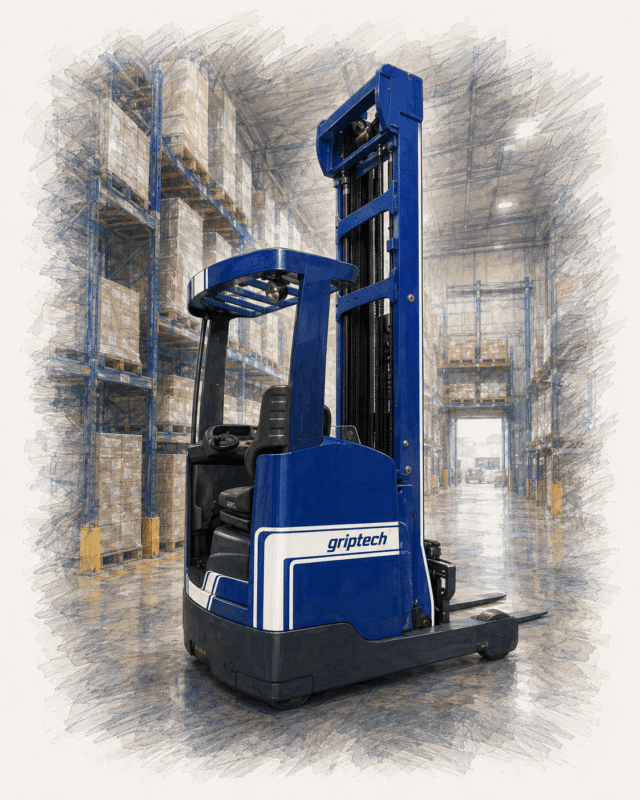
Heavy-duty forklifts for particularly heavy loads
Heavy-duty forklifts are designed for loads that cannot be safely moved with conventional forklifts. They feature particularly robust frames, powerful drives, and reinforced lifting masts.
Depending on their design and load capacity, heavy-duty forklifts move large machines, steel products, concrete components, containers, or other heavy industrial goods. Their actual load capacity depends, among other things, on the load's center of gravity, the lifting height, and the load-handling attachment used.
Typical areas of application for heavy-duty forklifts
Heavy-duty forklifts are frequently used in:
- steelworks and foundries
- Industrial machinery and equipment
- Ports and container terminals
- Shipyards
- Concrete and building materials industry
- Wood and paper industry
- Production facilities for heavy industrial goods
Although these forklifts move heavy loads, they must operate precisely and with control. Even minor driving or positioning errors can cause significant damage when handling bulky goods.
Safety and load control for heavy-duty forklifts
As vehicle size increases, good visibility and reliable monitoring of the surroundings become increasingly important. Camera systems can cover areas around the forklift that are difficult to see. Radar and assistance systems They help to identify people or obstacles at an early stage.
Hydraulic weighing systems They allow the weight of a load to be determined during the lifting process. This helps to avoid overloading and to better document material flows.
Griptech also offers special applications KOOI®Reachforks available in heavy-duty versions. These make it possible to telescopically lift or position even large and heavy loads.
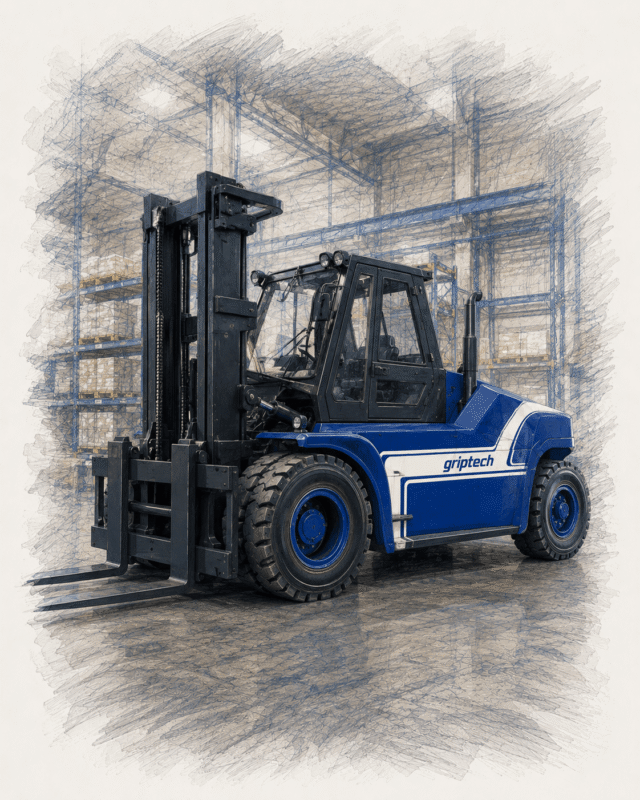
Reach stacker for container handling
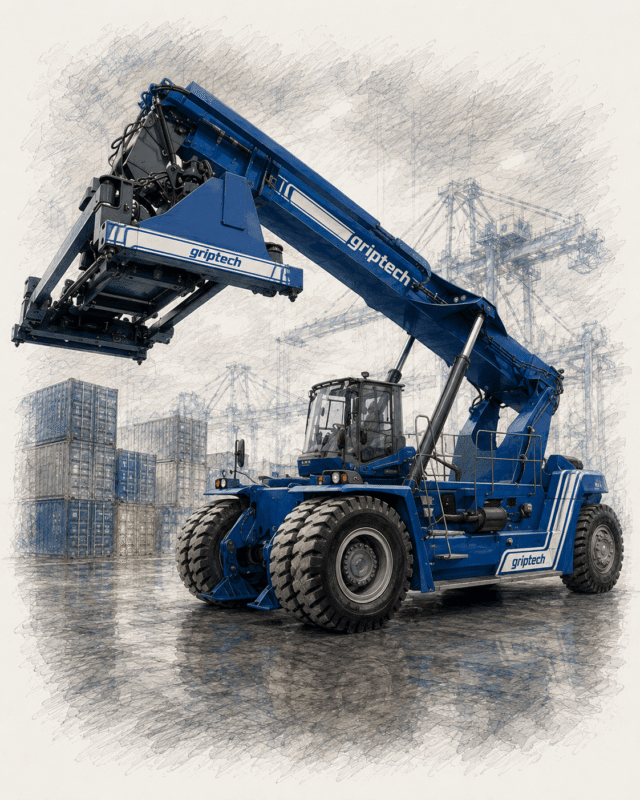
Reachstackers are specialized industrial trucks for handling containers and swap bodies. They are primarily used in ports, container terminals, freight yards, and intermodal logistics centers.
Unlike a conventional forklift, the load-handling attachment is not located on a vertical lifting frame. A reach stacker has an angled telescopic boom. At its end is a spreader that picks up the container from above.
By extending its boom, a reach stacker can reach over containers that have already been placed there. This allows containers to be picked up and set down even in the second or third row.
Advantages of a reach stacker
Reachstackers offer, among other things, the following advantages:
- flexible container handling
- great coverage
- high throughput speed
- Stacking multiple containers on top of each other
- Deployment at rail and truck terminals
- lower infrastructure costs than with permanently installed crane systems
With special load-handling attachments, certain reach stackers can pick up not only containers but also swap bodies or complete semi-trailers.
Weighing and safety systems for reach stackers
Weight control plays a crucial role in container handling. hydraulic weighing system It can determine the weight of a container during handling. Depending on the system, vehicle, and calibration, precise and documentable weight data can be recorded.
Camera systems They assist the driver in picking up, stacking, and setting down the containers. Additional Surround and radar systems They help to monitor areas that are difficult to see and reduce the risk of accidents at the terminal.
Side loader for long and bulky goods
Side loaders are specifically designed for transporting long loads. These include, for example, bundles of wood, steel profiles, pipes, sheets, and other long goods. The load is picked up from the side and placed on a loading platform next to the driver's seat while the vehicle is in motion. This prevents the load from protruding far in front of or behind the vehicle. Long goods can thus be transported even through relatively narrow aisles. Side loaders are particularly common in the timber, steel, and building materials industries. For safe operation, they require sufficient space for picking up and placing the load laterally.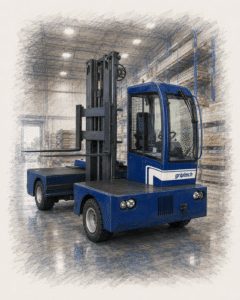
Four-way forklift for long goods and confined storage areas
Four-way forklifts combine the features of front and side loaders. Their wheels can be aligned so that the vehicle can move not only forwards and backwards, but also sideways.
This allows long loads to be picked up from the front and then transported laterally through a narrow aisle. Four-way forklifts are particularly suitable for companies that need to move both pallets and long goods.
Typical areas of application are:
- timber trade
- Metal and steel trading
- Building materials depot
- Window and profile manufacturing
- Storage of pipes and plates
Thanks to their flexible direction of travel, four-way forklifts can use the available storage space particularly efficiently.

Narrow aisle forklifts for maximum storage density
Narrow aisle forklifts are designed for particularly narrow aisles. They are used when the goal is to create as many storage locations as possible in a limited space.
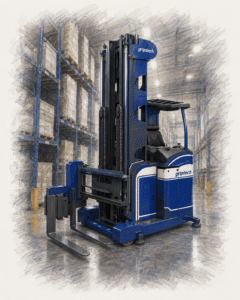
Depending on the design, either only the forks or the entire operator's cab is raised. With so-called man-up pallet trucks, the operator rises together with the cab. This allows for both pallet storage and order picking.
Narrow aisle forklifts are often guided safely through the aisle by guide rails or inductive systems. This eliminates the need for free-running steering within the warehouse aisle.
Camera systems and positioning aids can assist the driver in the precise picking up and placing of pallets at great heights.
Telescopic handlers for construction sites and agriculture
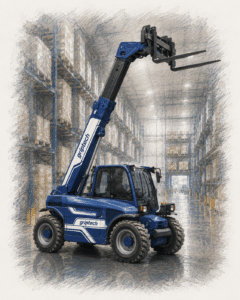
Telescopic handlers, also known as telehandlers, have an extendable telescopic arm. This allows them not only to lift loads but also to move them forward over obstacles. They are frequently used on construction sites, in agriculture, in recycling plants, and in industry. Many models have all-wheel drive and are designed for driving on unpaved surfaces. Telescopic handlers can be equipped with various attachments, including:- Fork carrier
- shovel
- grab
- working platforms
- load hook
Electric low-lift pallet trucks for pallet transport
Electric pallet trucks are designed for the horizontal transport of pallets. Their forks lift the pallet only enough to allow it to be moved freely off the ground.
They are primarily used in warehouses, supermarkets, production facilities, and distribution centers. Compared to forklifts, pallet trucks are more compact and easier to maneuver in confined spaces.
Depending on the area of application, there are different designs:
- Tiller-guided low-lift trucks
- Low-lift pallet truck with driver platform
- Low-lift pallet truck with driver's platform
- Low-lift pallet truck with side-mounted driver's seat
Tiller-guided vehicles are particularly suitable for short distances. For longer transport routes, models with a driver platform or fixed driver's station are often used.
Weighing systems for low-lift pallet trucks
Low-lift pallet trucks can be equipped with integrated weighing systems The vehicle can be equipped or modified accordingly. The weight of the pallet is then measured directly on the vehicle.
Such a system can eliminate the need for additional trips to a stationary scale and integrate weight control directly into the material flow. This is helpful, for example, during goods receipt, order picking, or shipping.

Electric high-lift pallet trucks for transport and storage
High-lift pallet trucks combine the compact design of a pallet truck with the ability to lift pallets and store them in racks.
They are frequently used in smaller warehouses, workshops, production areas, and sales floors. For low-volume goods handling, they can be an economical alternative to a traditional forklift.
Besides simple manual models, there are electrically powered pallet trucks with varying lifting heights and load capacities. Most of these devices are designed for short to medium transport distances.
Typical tasks of a high-lift truck
High-lift pallet trucks perform, among other tasks:
- Storing and retrieving pallets
- Loading and unloading of vehicles
- Provision of goods
- Loading machines
- internal transport
Due to their design, high-lift pallet trucks should generally be used on level and sufficiently load-bearing surfaces. The permissible load capacity decreases depending on the lifting height and the load's center of gravity.
High-lift trucks can also be equipped with weighing technology It can be equipped with this feature. This allows the weight of a pallet to be checked directly during transport or storage.

Scissor lift trucks for an ergonomic working height
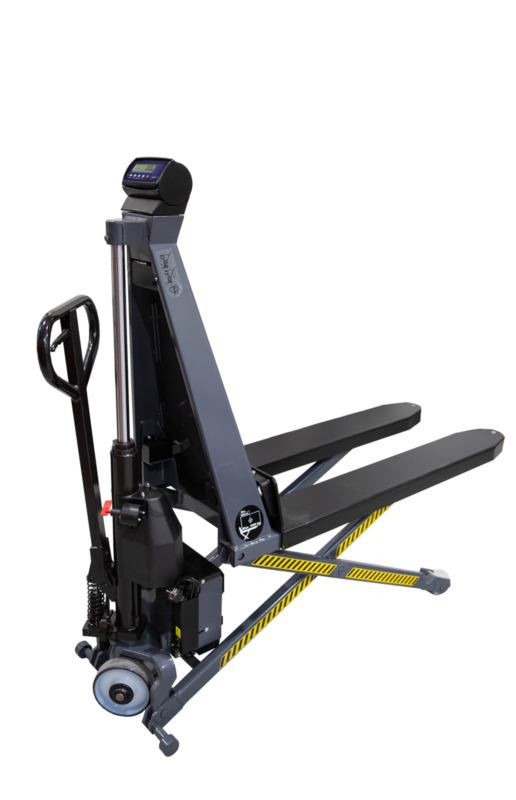
Scissor lift trucks raise pallets and load carriers to an ergonomic working height using a scissor mechanism. They therefore serve not only for transport but also as mobile work platforms.
In production facilities, employees can remove components or goods without having to constantly bend down. This facilitates ergonomic work and can reduce physical strain.
Scissor lift trucks are used, among other things, for:
- Assembly work
- Commissioning:
- Machine feeding
- Packaging work
- Goods inspection
- production processes
Depending on the model, lifting is done manually, electrically, or electro-hydraulically.
Griptech also offers Weighing scissor lift trucks This allows a load to be lifted to working height and weighed simultaneously. This makes it possible to combine several work steps.
Hand pallet trucks for short transport routes
The hand pallet truck, often also called a pallet jack, is one of the most widespread types of material handling equipment. It has two forks that are inserted under a pallet. By pumping the tiller, the pallet is hydraulically lifted and can then be moved.
Hand pallet trucks do not require an electric drive. They are simple in design, versatile in their use, and relatively inexpensive.
Typical areas of application are:
- Warehouses
- Retail
- workshops
- Production plants
- Truck loading areas
- Shipping and receiving areas
Manual pallet trucks are best suited for short distances and level floors. For long transport routes or frequent use with heavy loads, electric pallet trucks are usually more ergonomic.
Weighing hand pallet trucks
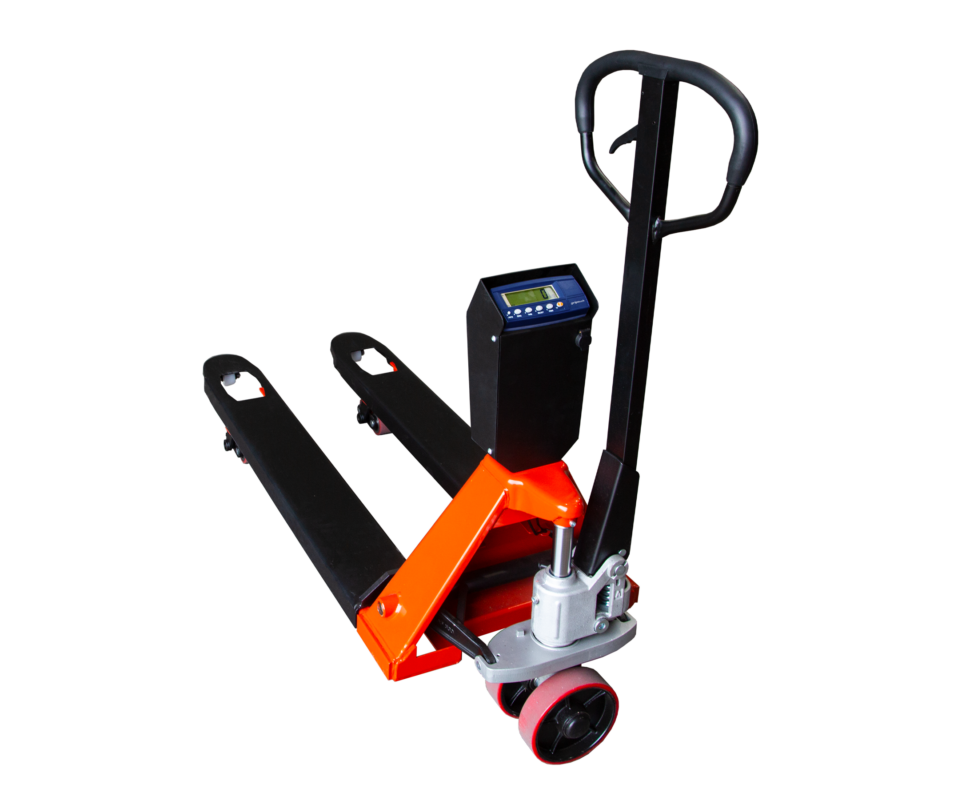
At a weighing hand pallet truck Load cells are integrated into the vehicle. The weight of the picked-up pallet is displayed directly on a display device.
This allows goods to be weighed during transport. Mobile weighing pallet trucks are suitable, for example, for inventory control, dosing tasks, incoming goods inspections, and shipping processes.
Electric, diesel or LPG forklifts?
Besides the design, the drive system is also an important distinguishing feature for forklifts.
Electric forklift
Electric forklifts operate with zero local emissions and are relatively quiet. They are therefore frequently used indoors. Modern battery systems also enable longer and more intensive work periods.
Diesel forklifts
Diesel forklifts offer high performance and are frequently used outdoors. They are particularly suitable for heavy loads and demanding operating conditions.
LPG forklifts
LPG forklifts combine high availability with a comparatively clean combustion process. Whether they are permitted for indoor use depends on the specific working conditions and safety requirements.
The type of drive that is suitable depends on the duration of use, the working environment, the load-bearing capacity, the energy supply and the operational requirements.
Which type of forklift is the right one?
Choosing the right type of forklift depends on several factors. The weight of the load is not the only decisive factor.
Before making a selection, the following questions, among others, should be answered:
- What loads need to be transported?
- How heavy and how large are the goods?
- At what height are the goods stored?
- How wide are the existing driving and storage aisles?
- Will the forklift be used indoors or outdoors?
- What are the soil conditions?
- How long are the transport routes?
- Are special attachments required?
- Should the load be weighed during transport?
- Are there any areas that are difficult to see into?
For flexible, standard tasks, a counterbalance forklift is often suitable. In narrow high-bay warehouses, a reach truck or narrow-aisle forklift offers advantages. Long goods can be moved more efficiently with side-loading or four-way forklifts. For short pallet transports, low-lift pallet trucks or hand pallet trucks are often sufficient.
Extend forklifts with suitable attachments
A forklift can be equipped with suitable Attachments They can be adapted to different transport tasks. This eliminates the need to purchase a separate vehicle for each type of load.
Possible accessories include:
- Telescopic forks
- Fork positioners
- Sideshift
- Multi pallet handler
- Clamps
- Roll clamps
- Spinning Playground Equipment
- Weighing systems
- Camera systems
- Radar and assistance systems
Griptech develops and supplies solutions for different types of forklifts and applications. These include telescopic forks, hydraulic attachments, mobile weighing technology, and camera and safety systems.
Which equipment is suitable always depends on the forklift model, the load capacity, the load center of gravity and the specific application.
Conclusion: There is a suitable type of forklift for every application.
The different types of forklifts vary significantly in their design and application. Counterbalance forklifts are versatile all-rounders, while reach trucks and narrow-aisle forklifts are designed for efficient storage in confined spaces.
Heavy-duty forklifts move particularly heavy industrial goods. Reach stackers handle containers. Side-loading and four-way forklifts are specialized for long loads, while telescopic handlers demonstrate their strengths on construction sites and unpaved surfaces.
For simple pallet transport, hand pallet trucks and electric pallet trucks are available. High-lift pallet trucks can also be used for storing pallets, while scissor lift pallet trucks provide an ergonomic working height.
Suitable attachments, weighing systems and camera solutions allow the different types of forklifts to be further adapted to the respective work processes.
Frequently asked questions about forklift types
What types of forklifts are there?
The most important types of forklifts include counterbalance forklifts, reach trucks, heavy-duty forklifts, side loaders, four-way forklifts, narrow-aisle forklifts, and telescopic handlers. Low-lift pallet trucks, high-lift pallet trucks, scissor lift pallet trucks, and hand pallet trucks are also considered industrial trucks.
What is a counterbalance forklift?
A counterbalance forklift is a front-loading forklift where the load is picked up in front of the vehicle. A counterweight at the rear balances the weight of the load and ensures the necessary stability.
What is the difference between a front forklift and a counterbalance forklift?
The terms front loader and counterbalance forklift are often used for the same type of forklift. "Front loader" describes the loading mechanism located at the front of the vehicle. "Counterbalance forklift" refers to the counterweight at the rear of the vehicle.
What is the difference between high-lift pallet trucks and low-lift pallet trucks?
A low-lift pallet truck raises a pallet only a few centimeters and is primarily used for horizontal transport. A high-lift pallet truck has a lifting mechanism and can also store pallets in racks.
Which forklift is suitable for narrow aisles?
Reach trucks and narrow-aisle forklifts are particularly suitable for narrow warehouse aisles. Which type is more suitable depends, among other things, on the aisle width, the lifting height, and the desired throughput.
Which forklift is suitable for long loads?
Side loaders or four-way forklifts are frequently used for wood, pipes, steel profiles and other long goods. These can transport long loads lengthwise in a space-saving manner.
Which forklift is suitable for outdoor use?
For outdoor use, diesel, LPG, rough terrain, or telescopic forklifts are frequently used. The decisive factors are the ground conditions, the required lifting capacity, and the specific working environment.
Can a forklift weigh a load directly?
Many forklifts and pallet trucks can be equipped with mobile weighing systems. Depending on the vehicle, hydraulic weighing systems or solutions with integrated load cells are used. This allows the weight to be determined directly during goods handling.