


Weighing systems for forklifts: Weighing loads directly in the material flow
With a Weighing system for forklifts Pallets and other loads can be weighed directly during transport, order picking, or loading. This eliminates the need for additional trips to a weighbridge. stationary floor scale This eliminates the need for manual steps, and the determined weight is immediately available for control, documentation, or data transfer.
Depending on the application, a hydraulic forklift scale, swaying fork carrier Or a system with load cells might be the right solution. But how do the different technologies differ? What level of accuracy is required? And can a forklift scale be retrofitted to an existing vehicle?
This guide provides an overview of the most important weighing systems for forklifts and shows which solution is suitable for which application.
What is a weighing system for forklifts?
A weighing system transforms the forklift into a mobile scale. The load no longer needs to be transported to a separate floor or platform scale, but is weighed directly at the vehicle.
The weight is displayed on a screen in the driver's cab. Depending on the configuration, tare, net, and gross weights can also be recorded, multiple weighings added together, order data assigned, labels printed, or information transferred to an ERP or inventory management system.
Mobile weighing technology is suitable for, among other things:
- Goods receipt and goods issue
- Commissioning:
- Shipping control
- Production supply
- Inventory control:
- Item count
- Loading of vehicles
- Just-in-time and just-in-sequence processes

What are the advantages of a forklift scale?
With a stationary scale, transporting and weighing are two separate work steps. The forklift must pick up the goods, drive to the scale, perform the weighing, and then continue the actual transport.
A weighing system for forklifts integrates weight determination directly into this process.
This results in several advantages:
Shorter journeys
The detour to a stationary scale is eliminated. Especially with many daily weighing operations, this can significantly reduce internal travel distances.
Fewer process steps
Picking, transporting, and weighing are all done with the same vehicle. The goods do not need to be unloaded or transshipped separately.
Direct weight control
Discrepancies can be detected during order picking or before loading. This reduces the risk of shortages, overloads, or incomplete deliveries.
Better documentation
Weighing data can be assigned to an order, an item, a product group, or a user ID. With suitable interfaces, it can be digitally stored and further processed.
Flexible usage
Mobile weighing systems can be used where goods are moved anyway – for example in the warehouse, in production, outdoors or at the loading ramp.
What weighing systems are available for forklifts?
Basically, a distinction is made between hydraulic weighing systems and load cell-based solutions.
Both technologies can be used directly on the forklift, but differ in their functionality, accuracy, robustness and integration.
Hydraulic weighing systems for forklifts
A hydraulic weighing system determines the weight via the pressure in the forklift's lifting system. For this purpose, a measuring block is integrated into the vehicle's hydraulics.
The measuring technology is protected inside the vehicle. This makes the hydraulic technology particularly suitable for robust applications, changing attachments, and demanding working environments.
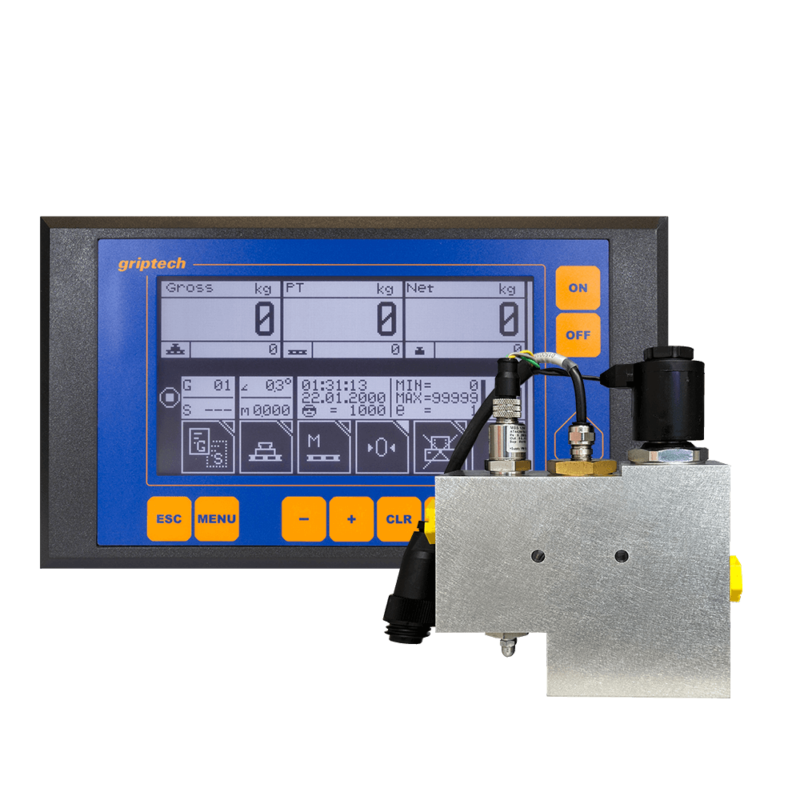
The TC EVO hydraulic weighing system
The TC EVO The Griptech unit is connected directly to the main line to the lifting frame via a compact measuring block. An additional return line to the tank is not required.
The driver activates the weighing process on the display device and lowers the load in a controlled manner. The weight is displayed within approximately three seconds.
Depending on the type of industrial truck, the TC EVO achieves an accuracy of ±0,2 to ±0,5 percent of the vehicle's load capacity. The system can be used on pallet trucks, high-lift pallet trucks, reach trucks, and counterbalance forklifts, among others. Since no additional weighing components are mounted in front of the fork carriage, the vehicle's load capacity is not affected by the system.
Hydraulic weighing systems are particularly suitable when:
- A robust and protected solution is needed.
- different loads are transported,
- existing attachments should continue to be used,
- the vehicle is to be retrofitted,
- A reliable checkweighing is the central focus.
Load cell-based weighing systems
In load cell-based systems, the material deformation caused by the load is electronically detected. The load cells can be integrated, for example, into the fork tines, a fork carriage, or a vehicle.
The weight is usually displayed immediately upon lifting or after picking up the load. Load cell-based systems are therefore particularly suitable for applications with many consecutive weighing operations.
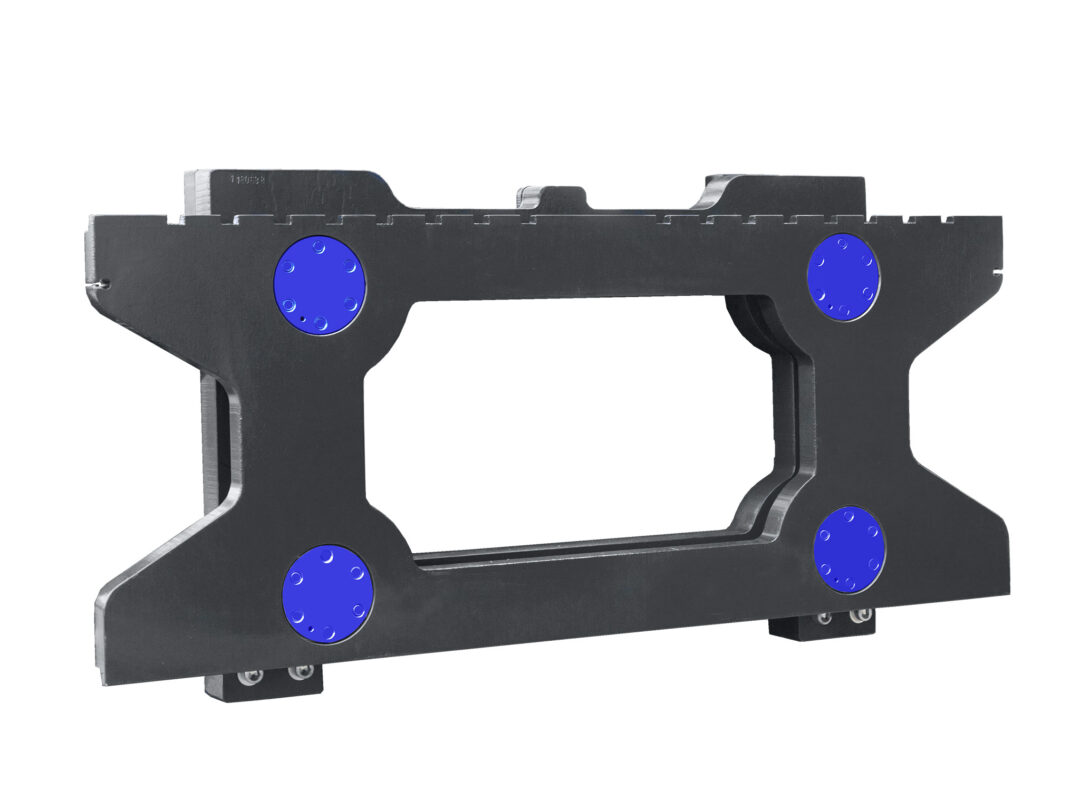
Weighing fork carriage WGT
The WGT weighing fork carriers Griptech products are either mounted as an add-on device on the existing fork carriage or integrated directly into the lifting frame.
The integrated version allows for a reduction in overall length and weight. Standard forklift tines or suitable attachments can be mounted on the WGT.
Four load cells ensure consistent load measurement. The system allows weighing at different lifting heights and achieves an accuracy of ±0,5 percent of the actual weight weighed.
Load cell-based systems are particularly suitable when:
- the weight should be displayed immediately
- many weighing processes take place one after the other,
- Even smaller weight differences are relevant,
- where piece counting or dosing processes are planned,
- A defined weighing accuracy is required in relation to the current load.
Hydraulic weighing system or load cells?
Which technology is more suitable depends on the specific application.
| Criterion | Hydraulic weighing system | Load cell-based system |
|---|---|---|
| Measuring principle | Pressure measurement in lifting hydraulics | Electronic measurement of the load |
| Installation | Integration into the vehicle hydraulics | Integration into tines, fork carriage or vehicle |
| Protection of the sensors | Protected inside the vehicle | The sensors are located closer to the load-bearing point. |
| Weighing process | Brief controlled raising or lowering | Weight display when picking up the load |
| Influence on stem dimensions | Usually no additional extension | Depending on the version |
| Typical use | Robust checkweighing and retrofitting | Fast and precise process weighing |
| Combination with attachments | Very possible | Depending on the system design |
| Calibration | Depending on vehicle and system | Depending on the design and load cells |
A hydraulic system is often the right choice when an existing forklift needs to be retrofitted in the most compact way possible. A load cell-based system offers advantages when the weight needs to be available as quickly as possible without additional weighing.
Can a forklift scale be retrofitted?
Many weighing systems can be retrofitted to existing industrial trucks. Which solution is suitable depends on several factors, including:
- vehicle type
- Capacity
- Lifting frame
- Hydraulic system
- existing attachments
- required accuracy
- Work environment
- desired data transfer
- Requirements for a verifiable version
Hydraulic systems as the TC EVO They are integrated directly into the lifting hydraulics. This means that the existing forks and attachments are generally retained.
Weighing fork carriers or weighing forks They are mounted on the load-bearing surface or integrated into the lifting frame. The forklift's own weight, the overall dimensions, and the resulting residual load-bearing capacity must be taken into account.
Therefore, before retrofitting, it should always be checked how the selected system affects the vehicle, load center and residual load capacity.
How accurate does a forklift scale need to be?
Not every application requires the same level of weighing accuracy.
Different requirements apply for a simple check to determine whether a pallet is complete or a vehicle could be overloaded than for billing by weight or in the case of particularly small weight differences.
It is also crucial to understand what the accuracy specification refers to:
Accuracy related to vehicle load-bearing capacity
In hydraulic weighing systems, accuracy is often specified as a percentage of the forklift's nominal load capacity.
For a vehicle with a load capacity of 2.500 kilograms, 0,2 percent corresponds, for example, to a possible deviation of 5 kilograms.
Accuracy based on the weighed weight
In load cell-based systems, the accuracy can refer to the actual load absorbed.
For example, with a weight of 1.000 kilograms, 0,5 percent corresponds to a possible deviation of 5 kilograms.
Therefore, the percentage values of different systems should not be compared without taking the respective reference value into account.
When is a legally compliant weighing system required?
Checkweighing within a company does not automatically require a calibrated scale. However, if weight values are used in commercial or official transactions, the regulations of weights and measures law may be relevant.
This applies, for example, to situations in which:
- Goods are sold or billed by weight
- the weight is the basis of a calculation
- Officially relevant weight data is generated,
- Weight values are used in a legally binding manner with respect to third parties.
"Certifiable" initially means that a system can be provided in a suitable configuration. This is not automatically equivalent to a scale that has already been calibrated and approved for its intended purpose.
The specific requirements should be checked before selecting a system for the respective application. For particularly high accuracy requirements, Griptech, for example, offers the TC4000 hydraulic weighing system with an accuracy of ±0,1 percent of the vehicle's load capacity and a verifiable version.
Typical applications of mobile weighing technology
Goods Receipt
Incoming pallets can be checked as soon as they are unloaded. The determined weight can be compared with delivery note or order data.
Commissioning:
During order fulfillment, the current weight can serve as an additional control parameter. If the individual weights of the products are known, the total weight can be used to verify whether the intended quantity has been received.
Goods issue and shipping
Before loading, the plausibility of the shipping weight can be checked. Weighing data can also be provided for shipping documents or labels.
Production
Raw materials, intermediate products, or finished parts can be weighed directly upon delivery. This supports material consumption, traceability, and inventory management.
Waste and recycling management
Material quantities can be recorded directly during internal transport and assigned to different areas, orders or cost centers.
Weighing technology in just-in-time and just-in-sequence processes
Just-in-time and just-in-sequence processes rely on the timely and correct delivery of materials. Even a single missing component can disrupt the subsequent production process.
Therefore, weight checks directly on the forklift can be integrated into the order picking process as an additional check step.
A typical process might look like this:
- The driver scans the production or shipping order.
- The goods intended for shipment are being picked.
- The forklift determines the total weight of the load being picked up.
- The actual weight is compared to the stored target weight.
- If the order matches the original description, it will be released.
- Optionally, a shipping or identification label can be printed automatically.
- If a deviation occurs, the process is flagged for review.
Weight control does not necessarily replace other testing methods. It complements them by providing a quickly available and objective control parameter.
Digitally capture and transmit weight data
The benefits of a forklift scale don't end with displaying the weight. With suitable interfaces, the collected data can be directly integrated into other processes.
The Griptech SmartBox This turns the forklift into a mobile data collection unit when combined with a weighing system.
The standard configuration can process, among other things, the following information:
- Gross, net and tare weight
- Date and Time
- Driver or user ID
- Scanner information
- Order and product group data
- individual and cumulative weighings
The SmartBox has 32 GB of storage and can archive more than one million weighing transactions. Handheld scanners and printers can be directly integrated into the process. Captured data can also be transferred to an inventory management system via Wi-Fi or mobile network.
This makes the following processes possible, for example:
- Transfer of weighing data to ERP or WMS systems
- Comparison of target and actual weight
- Assignment of a weighing to an order
- automatic release of a shipping process
- Issuance of labels or weighbridge tickets
- Documentation for traceability and quality assurance

Cost-effectiveness: When does mobile weighing pay off?
Whether the investment in a weighing system pays off depends primarily on the number of daily weighing operations and the distances previously required for them.
The following information is helpful for an initial assessment:
- Number of weighing operations per day
- average travel time to the stationary scale
- Time required for discontinuation and resumption
- Driver's personnel costs
- Operating costs of the forklift
- Possible waiting times at the scales
- Costs due to incorrect picking or overloading
- Effort required for manual data entry
Even a few minutes saved per weighing process can add up to a significant time saving with high daily usage.
Griptech's TC EVO Challenge allows you to calculate the potential return on investment of a mobile weighing solution based on the operational framework.
Which weighing system is suitable for your application?
Before making a selection, the most important requirements should first be defined:
- Which vehicle should be equipped?
- What types of loads are predominantly weighed?
- What level of accuracy is required?
- How many weighing processes take place daily?
- Are attachments used?
- Is a version that can be calibrated for legal metrology required?
- Do weighing data need to be stored or transmitted?
- Should a scanner or printer be connected?
- Will the vehicle be used indoors or outdoors?
- Is an existing forklift going to be retrofitted?
Based on this, a decision can be made as to whether a hydraulic weighing system, a weighing fork carriage, weighing forks or a completely weighing industrial truck represents the most economical solution.
Calculate return on investment now

ROI calculation for mobile weighing technology
Mobile weighing systems allow cargo to be weighed directly in the flow of goods – without additional travel to a stationary scale. This significantly reduces downtime and personnel costs. There are basically two technologies:
- Weighing systems with electronic load cells: These display the weight immediately upon lifting the goods. The load cells are usually integrated into the forks or fork carriage – but this also provides less mechanical protection than internally installed systems.
- Hydraulic weighing systems: These use the hydraulic pressure in the forklift to determine the weight. The technology is completely installed in the vehicle and is therefore particularly protected. The weighing process is carried out by briefly raising and lowering the load. The entire process takes approximately 3-5 seconds.
Conclusion: Weighing and transporting in one operation
Weighing systems for forklifts integrate weight control directly into the material flow. Additional trips to a stationary scale are eliminated, and weight data is available where the goods are being moved anyway.
Hydraulic forklift scales are particularly impressive due to their robust design, compact retrofitting capabilities, and excellent compatibility with attachments. Load cell-based solutions offer advantages for rapid, consecutive weighings and applications with higher weight measurement requirements.
By connecting to scanners, printers, SmartBoxes, and inventory management systems, the mobile scale becomes a digital data interface. This allows weighing to not only reduce transport distances but also support order picking, shipping control, and just-in-time processes.
Griptech offers a variety of mobile weighing systems for pallet trucks, high-lift pallet trucks, reach trucks, counterbalance forklifts, and heavy-duty applications. Together with you, we determine which technology, accuracy, and data connectivity best suit your needs.
How cost-effective mobile weighing really is? Find out in a fun way – in the TC EVO Challenge!
| Start TC EVO Challenge |  |